
Collaboration with Divorce Professionals
Divorce Housing Strategy supports attorneys, mediators, and financial professionals by introducing structured housing evaluation before settlement agreements are finalized.
Housing decisions during divorce often involve legal, financial, and lending considerations that must align to avoid long-term instability.
The Structural Gap in Divorce Housing Decisions
During divorce, housing decisions frequently intersect with multiple professional disciplines.
Attorneys negotiate settlement agreements.
Financial professionals evaluate long-term financial outcomes.
Mortgage professionals evaluate lending feasibility.
These systems do not naturally operate together.
When housing decisions are made without structured evaluation of mortgage feasibility, income treatment, debt allocation, and refinance timing, expectations and financial reality can diverge.
Divorce Housing Strategy introduces a framework designed to help close this gap.
Why Housing Decisions Can Become Settlement Risk
Housing decisions often represent the largest financial component within a divorce settlement.
However, several factors can influence whether a housing path remains feasible after settlement:
• refinance qualification
• treatment of support income
• debt reassignment
• title transfer timing
• payment sustainability
When these variables are not evaluated early, complications can emerge after settlement agreements are finalized.
Structured housing evaluation helps reduce this risk.
The Divorce Housing Strategy Framework
Divorce Housing Strategy organizes housing decisions into a structured evaluation process that supports informed decision-making during divorce.
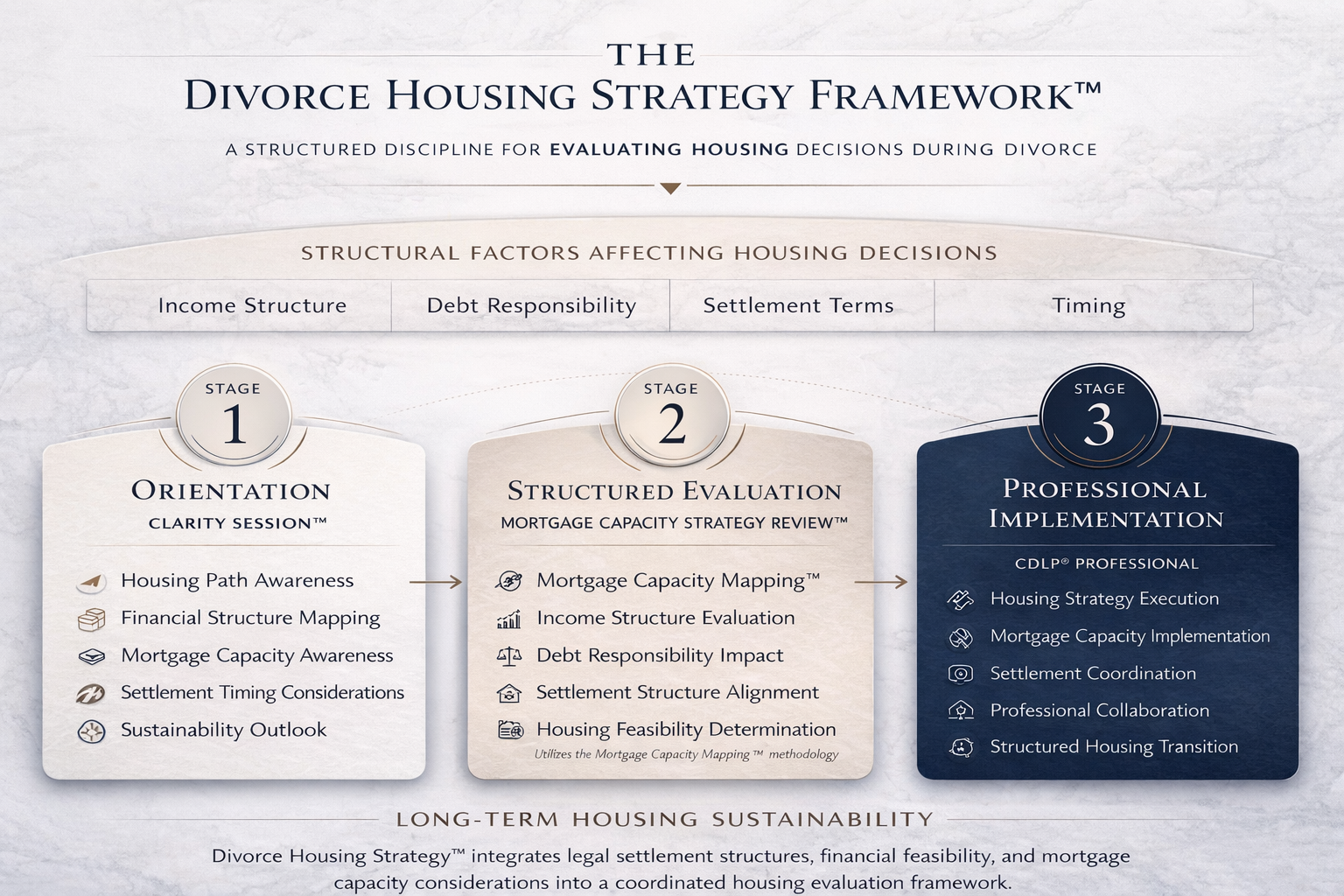
Divorce Housing Strategy™ integrates legal settlement structures, financial feasibility, and mortgage capacity considerations into a coordinated housing evaluation framework.
The framework unfolds across three stages.
Stage 1 — Orientation
The Divorce Housing Strategy Clarity Session™ helps individuals organize the financial realities surrounding housing decisions before commitments are finalized.
This stage introduces structure and prepares individuals for professional conversations.
Stage 2 — Structured Evaluation
The Mortgage Capacity Strategy Review™ provides a deeper evaluation of housing feasibility when settlement expectations must be tested against financial realities.
This stage examines:
• refinance feasibility
• income qualification factors
• debt allocation impact
• timeline considerations
Stage 3 — Professional Implementation
Certified Divorce Lending Professionals (CDLP®) collaborate with attorneys and financial professionals to help align housing decisions with mortgage feasibility during settlement and execution.
The Role of Certified Divorce Lending Professionals
Certified Divorce Lending Professionals specialize in the intersection of:
• divorce settlement structures
• real property considerations
• mortgage qualification realities
CDLP professionals support the professional team by helping evaluate whether proposed housing outcomes align with lending feasibility.
This collaboration helps reduce the risk of housing instability after divorce.
When Housing Strategy Is Most Valuable
Housing evaluation is most effective when introduced before settlement terms are finalized.
Early evaluation allows the professional team to:
• assess refinance feasibility
• understand income treatment implications
• identify potential qualification barriers
• explore alternative housing paths if necessary
This proactive approach supports more informed settlement decision-making.
Professional Collaboration
Divorce Housing Strategy welcomes collaboration with attorneys, mediators, financial neutrals, and other professionals involved in the divorce process.
If you are working with a client navigating housing decisions during divorce, the Divorce Housing Strategy framework may help introduce structured evaluation before commitments are finalized.
Connect with a CDLP® ProfessionalBuilt Within the Divorce Lending Association
Divorce Housing Strategy operates as a division of the Divorce Lending Association.
The Divorce Lending Association supports professionals who specialize in the intersection of divorce, housing, and mortgage financing.
The framework presented here reflects the structured evaluation principles used by Certified Divorce Lending Professionals when working alongside attorneys, mediators, and financial professionals navigating complex housing decisions during divorce.